by Barry Halverson, Co-Chair, Lake Lawrence Lake Management District
Your lake is a valuable resource and protecting it requires a proactive approach. The single most important step many communities have already taken is establishing an organized body dedicated to lake health. If your community already has a Lake Improvement District, a Lake Management District, a Special Use District or even a dedicated Lake Association, you are off to a great start!
Organizations that make a difference
If your lake is under the jurisdiction of one of these formal organizations, you have powerful tools at your disposal:
- Existing Lake Improvement Districts (LIDs) (formed before July 1985): If you have an LID formed before July 1985, do everything you can to sustain it and keep it from lapsing – it can be a powerful mechanism for protecting your lake.
- HOAs owning the entire lake: While rare, if this applies to you, your Board of Directors has the authority to manage the lake directly, obtain permits through the Washington State Department of Ecology, and use authorized procedures codified in the Washington State Aquatic Plant and Algae Management General Permit.
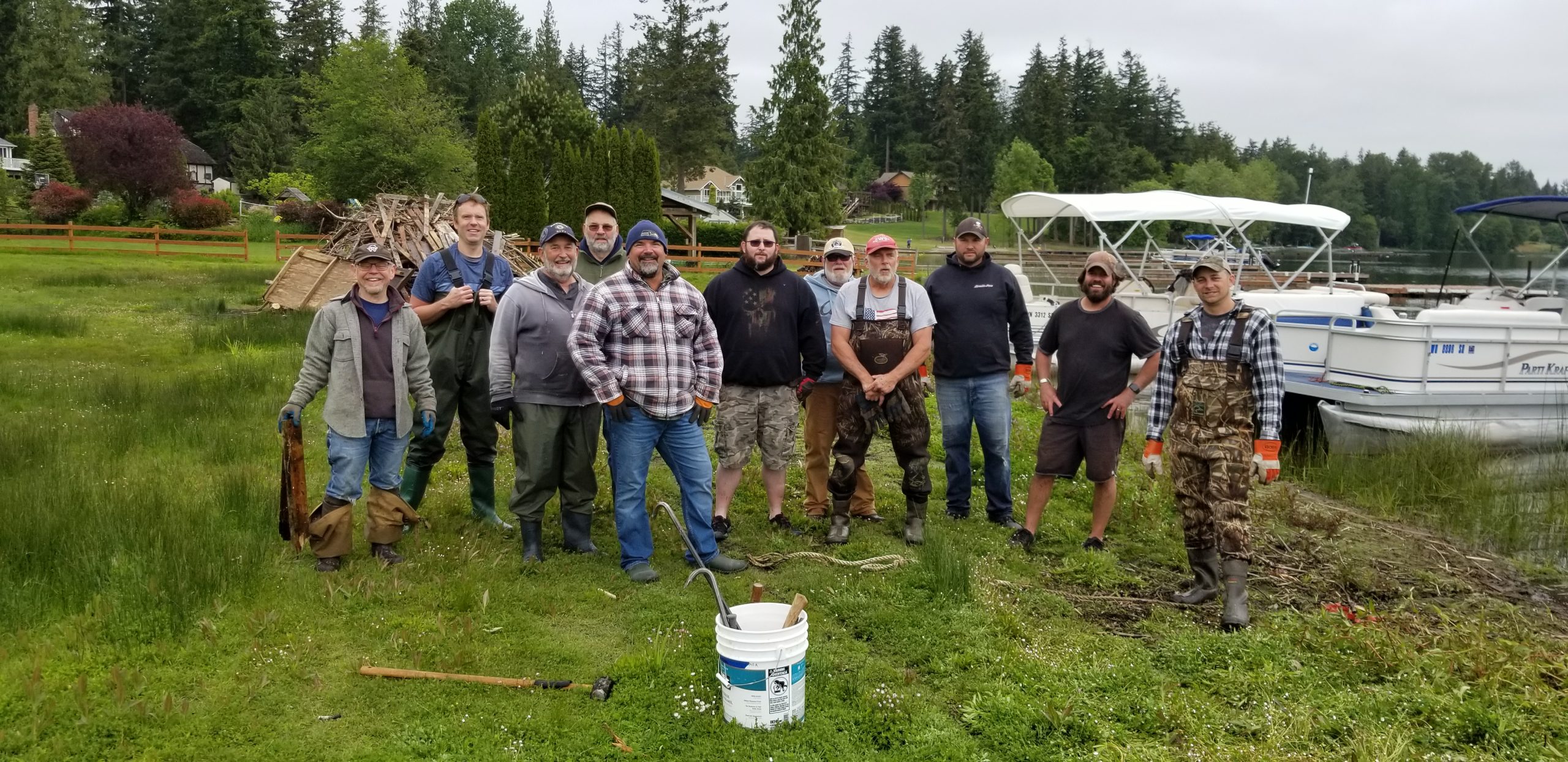
- Lake associations: These groups, powered by dedicated volunteers, are excellent at raising interest, awareness, gathering contacts, raising funds, and educating residents about reducing pollutants (e.g., by building rain gardens). However, their ability to control noxious and invasive aquatic vegetation or harmful algae blooms (HABs) is limited, often only to manual removal.
What if you don’t have an organization?
If your lake currently lacks one of the organized groups listed above, do not despair!
- Identify and address weeds: If you notice noxious or invasive aquatic vegetation, immediately contact your city or county Noxious Weed Board or Department. Even without a quasi-governmental organization, these departments can often work with the Department of Ecology to secure funding and assistance to eliminate harmful vegetation.
- Consider formalizing: If you have a passionate lake association, you might want to explore forming a more powerful, quasi-governmental organization like a Lake Management District (LMD) (RCW 36.61) or a Special Use District (RCW 85.38) to gain the authority to control invasive species. LMD’s in partnership with Thurston County have developed step-by-step instructions on how to form an LMD. They can be found in Appendix O at https://www.thurstoncountywa.gov/media/23897 The information and processes described there can be adapted for other counties and lake associations.
Ten steps to start a lake health organization
Building or revitalizing a lake organization takes dedication, but the rewards are immense – for your community, environment, fish, and wildlife.
- Engage the community. Bring neighbors together and talk about shared goals.
- Find passionate volunteers. A few energetic volunteers can make a big difference. It is not easy work, but it is rewarding. Improving water quality and fish and wildlife habitat is a laudable undertaking but it takes commitment.
- Reach out. Attend HOA and community meetings, build relationships, and spread the word. Get to know your community and grow support for your lake.
- Connect with local leaders. Get to know your local elected leaders. Support those that share your vision for better water quality and lake health. Interact with them and attend their meetings. If you already have a lake organization, invite these leaders to your meetings.
- Build your contact list. Start and grow a contact list at every event you attend. Use it to send out informative newsletters and updates to your community.
- Use social media. Create a website, Facebook page or other appropriate social media platform dedicated to lake health information. Update information regularly with content relevant to your audience.
- Volunteer locally. Volunteer or join city, county, or state boards and commissions, particularly those that impact your lake and water quality such as the Noxious Weed Board, Planning Commission, or Storm Water Advisory Board.
- Write and communicate. Author articles for your local HOA newsletter, community newsletter, and local print and online news sources to communicate your lake’s problems, goals, objectives, and needs.
- Support local parks and events. Provide any help you can to organizations and parks on your lake or in your area. Building goodwill helps create future partnerships.
- Keep learning. Educate yourself and others about your lake environment, including the rules and laws that affect the goals and objectives you have for your organization.

The payoff: a healthier, happier lake and community
Community involvement creates a ripple effect – healthier water, thriving fish and wildlife, and a stronger, more connected neighborhood. When you invest in your lake, everyone benefits!