
by Cecilia Welch, Climate and Water Epidemiologist, Washington State Department of Health
The majority of harmful algal blooms in Washington are attributed to cyanobacteria that grow in the water column and proliferate at the water’s surface, also known as planktonic blooms. For many years it was believed that planktonic blooms were the only kind of harmful algal bloom (HAB) and that those only occurred in lakes. The state’s public health guidance produced by the Department of Health (DOH) and the sampling program run by the Department of Ecology (DOE) all reflect this. However, in the past several years, another growth pattern has become more prominent that has presented both a public health concern and some perplexity due to its unprecedented nature. Benthic cyanobacterial mats that grow on the bottom of shallow, sunlit areas of large rivers have been linked to several dog deaths in Washington, most notably in 2021. Growth of these mats (also known more generally as periphyton) is by no means a new ecological phenomenon, but we have not been aware of toxic cyanobacteria-dominated mats like this in our regional rivers before. This is also part of a relatively newer area of research along the West Coast of the US, other countries, and even the Southern Hemisphere. In fact, most of the research on benthic cyanobacteria in rivers comes out of New Zealand where they have even identified the most problematic genera and developed monitoring guidance based on coverage and toxin concentration (McAllister, 2016).
Regardless of what is appearing in other parts of the world, in Washington we now know that there are two growth types associated with toxic cyanobacteria, which require different monitoring and response approaches. Planktonic blooms make up the vast majority of toxic blooms in the state and have been known to produce all four cyanotoxins (microcystins, anatoxin-a, cylindrospermopsin, and saxitoxin) that are currently analyzed as part of the state program (all data since the program’s inception are contained in the simple yet mighty NW Toxic Algae website). These blooms are relatively easy to identify, so the state guidance recommends using visual cues (e.g., obvious presence of a green or blue-green scum layer) to decide when to sample for toxicity. If those samples exceed the guidance values for any of the four cyanotoxins, advisories are issued along with public outreach and/or media releases as the local jurisdiction deems appropriate. This works well for the most part, although there has been the occasional winter bloom that does not follow the same criteria. For example, one lake in Stevens County experienced a red Planktothrix bloom that appeared in the middle of winter under ice. But in general, the state guidance through DOH and toxicity testing program through DOE have been shown to be protective of public health for planktonic blooms. And given that there is no other consistent annual funding at either the state or federal level for this work, it is imperative that these resources remain in place.
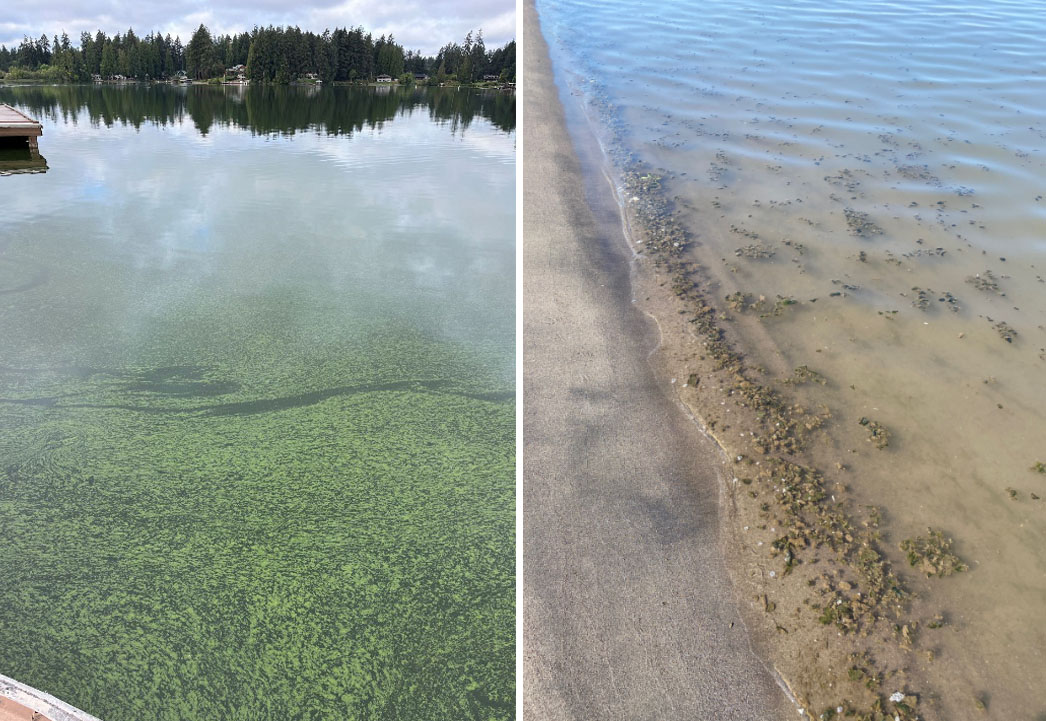
Figure 1. Photos highlight the difference between a planktonic bloom (left) and floating benthic mats (right). Photo credit: Cecilia Welch (DOH), Kurt Carpenter (USGS)
Benthic cyanobacteria, on the other hand, do not use the same visual cues as planktonic blooms because they are submerged during their growth phase and have a different ecology that must be understood to better monitor them, issue advisories, and inform the public about risk. These cyanobacteria often grow in mats that are attached to substrates in shallow, light-penetrating zones of rivers. Substrates can include woody debris, rocks, and sediment, and vary depending on river reach. Mats can also detach as they decay or become physically disturbed and carry toxin-laden biomass downstream. The genera that grow in benthic mats seem to produce mostly anatoxin-a and other anatoxin-a variants, which are potent neurotoxins lethal to animals (especially dogs) but can also cause tingling, numbness, muscle twitching, and loss of coordination in humans (Bouma-Gregson, 2018; Kelly, 2019). The type of dominant cyanotoxin generated is one difference that sets benthic cyanobacteria apart from planktonic. Another major difference is that benthic cyanobacteria can grow in relatively nutrient-poor water. Additionally, they have only been found and linked to animal deaths and human illness in the Columbia River in Washington, even though we know from scientific literature that both growth types are ecologically possible in rivers and lakes (Wood, 2020). Approaches to monitoring, sampling methods, and issuing advisories must also reflect these differences, which is particularly challenging because benthic mats are visually harder to identify and can affect large stretches of river, often crossing jurisdictional boundaries.
In an effort to capture the differences between planktonic and benthic cyanobacteria, the DOH modified the existing Washington State Recreational Guidance earlier this year to include a separate flow chart for benthic cyanobacteria and made signs highlighting the specific public health risks they pose. These modifications were done collaboratively with help from local jurisdictions with more active experience identifying these proliferations, namely Benton-Franklin Health District and Clark County Public Health. The signs below (found within the DOH HABs Toolkit along with the original signs) are available for order by local jurisdictions at freshwaterHABs@doh.wa.gov.

Figure 2. Benthic cyanobacteria-specific signs developed in 2025. See WA State Recreational Guidance for details on issuing advisories associated with these signs.
These materials are designed to guide and support on-the-ground efforts across the state, which vary widely based on local capacity. Holding public meetings, presenting in front of county boards of health, making county-specific signage, and building private-public partnerships are all ways local jurisdictions are working to bring awareness of the “new threat” of benthic cyanobacteria while also maintaining attention to planktonic blooms.
There is much that is not yet well understood, particularly about benthic cyanobacteria ecology in a changing climate, but we can be upfront about the unknowns while also working with what we know. Continuing to educate and communicate about our changing environment and staying connected to the scientific community are factors within our control and are essential to informing the public about distinctions between planktonic and benthic cyanobacteria. As we gain a clearer understanding of the science and subsequent public health risk, we will very likely have to work with each other to adjust our practices. But as many environmental scientists and public health practitioners know very well by now, this is par for the course.
References
- Bouma-Gregson, K., Kudela, R. M., & Power, M. E. (2018). Widespread anatoxin-a detection in benthic cyanobacterial mats throughout a river network. PLoS One, 13(5), e0197669.
- Kelly, L. T., Bouma-Gregson, K., Puddick, J., Fadness, R., Ryan, K. G., Davis, T. W., & Wood, S. A. (2019). Multiple cyanotoxin congeners produced by sub-dominant cyanobacterial taxa in riverine cyanobacterial and algal mats. PloS one, 14(12), e0220422.
- McAllister, T. G., Wood, S. A., & Hawes, I. (2016). The rise of toxic benthic Phormidium proliferations: a review of their taxonomy, distribution, toxin content and factors regulating prevalence and increased severity. Harmful Algae, 55, 282-294.
- Wood, S. A., Kelly, L., Bouma-Gregson, K., Humbert, J. F., Laughinghouse IV, H. D., Lazorchak, J., … & Davis, T. W. (2020). Toxic benthic freshwater cyanobacterial proliferations: Challenges and solutions for enhancing knowledge and improving monitoring and mitigation. Freshwater Biology, 65(10), 1824.