
by Ethan Fleming, Snohomish County intern
iNaturalist is a tool that lets the average lake resident make an impact on the health and quality of their lake. With a simple photo, noxious weeds can be identified, aquatic plant inventories made, and communities brought together. iNaturalist projects can help bridge the gap between citizen scientists and lake managers to create a simple database of aquatic life in the lake. From a curious visitor to an active community member, every observer can help groups working to keep our lakes healthy through iNaturalist.
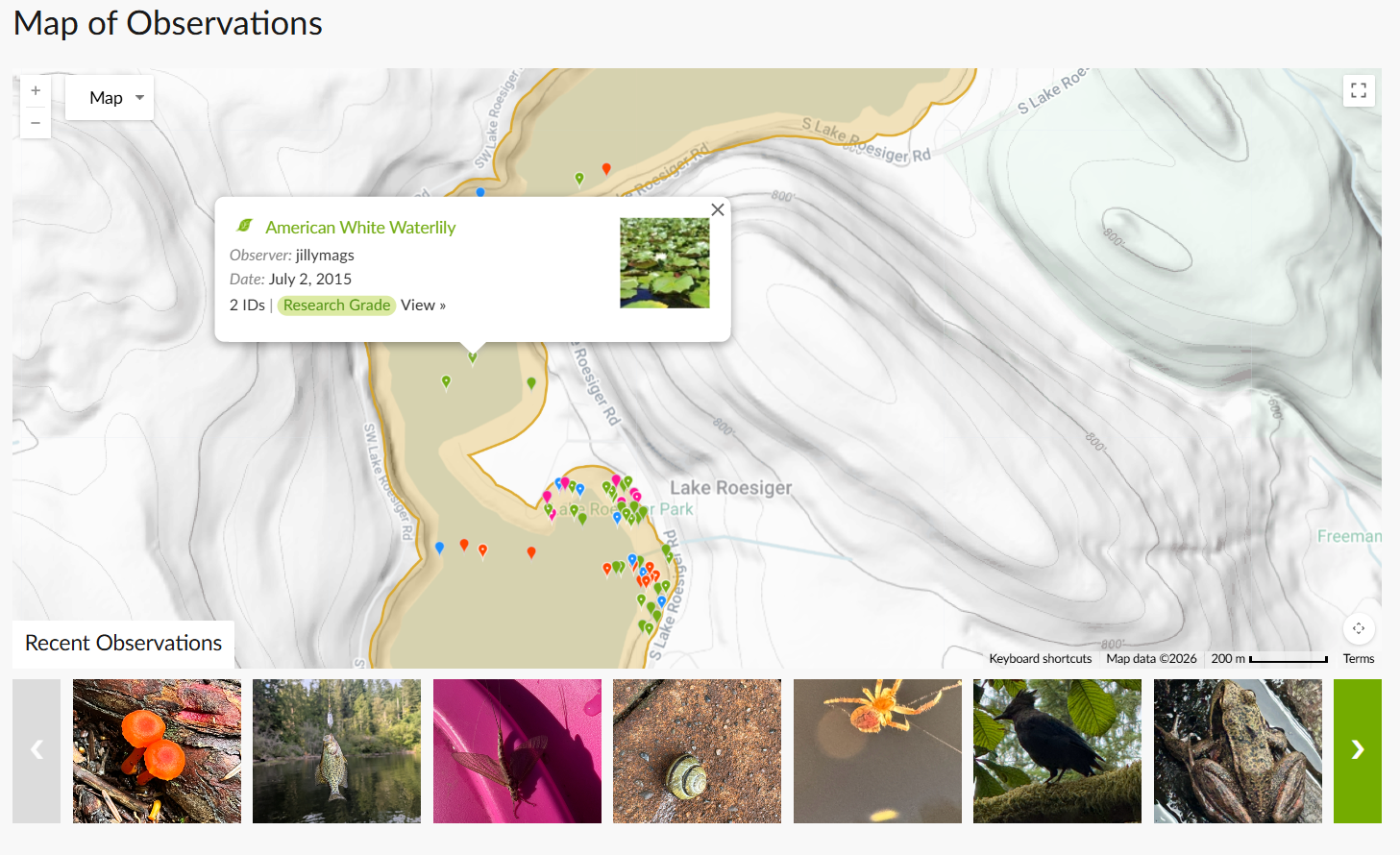
Example of observations made using iNaturalist at Lake Roesiger in Snohomish County
Anyone curious enough to take a photo of their natural world has been able to use iNaturalist for over a decade. The app has a robust AI feature that helps with identification and then is confirmed by other users. Each observation is also pinned on a map so others can view, confirm, or dispute any observations made. Through community involvement, observations can be labeled as “research grade”, making it easier for scientists and researchers to use the data.
“Projects” on iNaturalist– collections of user observations — are one of the app’s biggest selling points, working as a filter and hub for specific geographic locations and organisms. They’re set up to retroactively track and monitor the specific organisms that you’ve selected as well as creating a space for those observations to be viewed. Community members can also easily join these projects and be notified when new observations are added. For large lake communities, projects are a tool for group collaboration and discussion about what lives on the lake. And for smaller communities, it helps their observations to be seen by a larger audience.
While I was an intern at Snohomish County, we created projects for each lake the county managed, allowing us to have some form of monitoring even when we weren’t at the lake. This data was used to monitor noxious weeds and act as an early warning system if a new weed we didn’t know about were to pop up at a lake. Additionally, it provided a new tool for lake residents to use for aquatic plant and animal identification that could be used on top of our existing county resources. Projects also provided a way for community members to help identify observed plants and make a positive impact for the lake communities.
For lake managers and researchers using iNaturalist, it is easy to export and integrate the data generated into databases and projects. Since projects work as a pre-existing data filter, you can export the observations made into CSV files that can be easily converted to Excel spreadsheets as well as imported to GIS software. They also serve an important role as round-the-clock monitoring, especially in areas that are often surveyed less frequently by professionals. Having communities use iNaturalist gives lake managers access to a plethora of observations that can be made at any time of day or year.
Using iNaturalist can be a great help to lake managers and communities. For lake associations and managers, it creates an ongoing source of information that supports monitoring and early detection. For residents, it offers a direct and meaningful way to contribute to lake health. By connecting community members with lake professionals through one easy-to-use platform, iNaturalist helps turn everyday curiosity into informed action. When more people participate, the result is stronger collaboration, better data, and healthier lakes for everyone.