
by Wes Glisson, Aquatic Plant Specialist, Washington State Department of Ecology
(A longer version of this story appeared in the fall/winter 2024 issue of the Washington Native Plant Society’s journal Douglasia. Thanks to them for permission to reprint this material here.)
When I started my job a few years ago at the Washington State Department of Ecology, I came across some old educational materials tucked away among the folders at my new desk. One was a bumper sticker that says, “Stop spreading milfoil around!” I really like this bumper sticker. It’s bright yellow, it has a little STOP sign, a nice line drawing, and a very clear message. Unfortunately, despite how nice this bumper sticker is, milfoil (Myriophyllum spp.), specifically the invasive Eurasian watermilfoil (M. spicatum), did spread around. A lot. And it is still spreading.
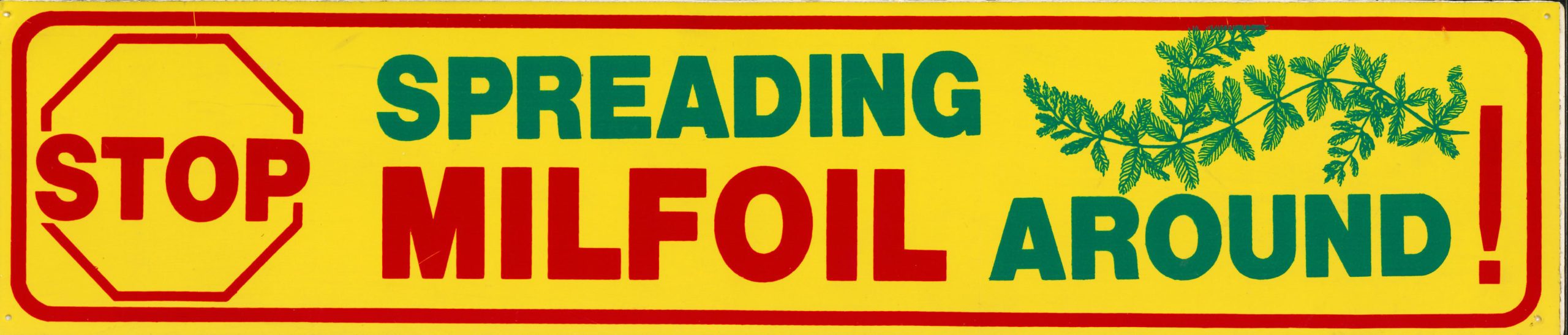
Bumper sticker to promote awareness and prevent the spread of Eurasian watermilfoil (Myriophyllum spicatum).
All prevention failures aside, the sticker and the decades of outreach that have accompanied the spread of Eurasian watermilfoil across the US have ingrained the name “milfoil” into the minds of many lakeshore property owners, fishermen, boaters, and water recreators. It’s impressive how many people I’ve met working in this field who know the name milfoil. The problem is that most of the “milfoil” that folks see on their lakes isn’t milfoil at all. Most of the “milfoil” I investigate turns out to be a myriad of other aquatic plant species: water naiads (Najas spp.), waterweeds (Elodea spp.), and pondweeds (Potamogeton spp.).
Sometimes I do find milfoil, and sometimes it is Eurasian watermilfoil, but not always. It often surprises people when I tell them they have one of our native watermilfoil species in their lake, and that there are actually a handful of native watermilfoils that grace our waters. These overlooked aquatic plants are diverse, beautiful, and ecologically important to Washington. Nonetheless, conservation of our native watermilfoil species is subject to several major challenges, including difficulty in observation and identification, and hybridization with their invasive cousins.
Observation
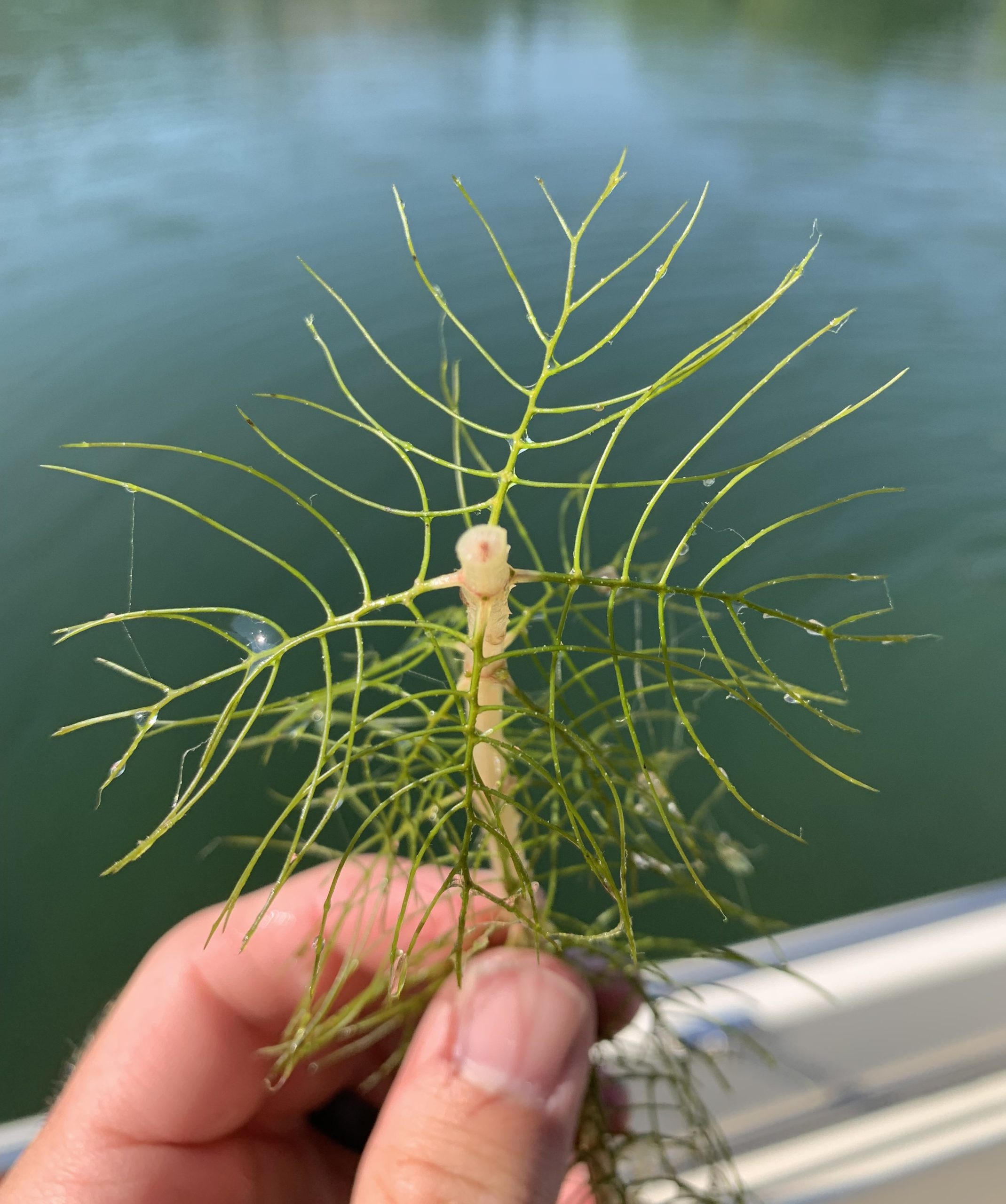
Submersed leaves of northern watermilfoil (Myriophyllum sibiricum). PHOTO: WESLEY GLISSON
Those interested in native plant conservation may be familiar with the concept of plant blindness, or plant awareness disparity as it has been more recently described (Wandersee and Schussler 1999, Parsley 2020). This condition is defined as the inability to notice plants, and hence, their intrinsic importance and value to our ecosystems and our lives. For aquatic plants, this issue is exacerbated by access to their habitats, the physical ability to see below the water’s surface, and general disinterest in the “weedy” portions of our fresh waterbodies. Most folks’ enjoyment of our natural waters relates to water clarity, both in terms of the suspended algae that gives some lakes their green color, and aquatic plants. Even for those interested in enjoying the aquatic plant community, the ripples from a light wind or the glare from the sun on a calm day preclude observation of the underwater flora (pro tip: wear polarized sunglasses for maximum aquatic plant enjoyment!). Thus, it is typically only those who snorkel, SCUBA, or use specially designed tools to sample aquatic plants who can truly appreciate these species. Because we often seek out and recreate in clear water and are generally unable to observe the aquatic plant community, we typically only see aquatic plants when they are growing more densely than usual or into an area that was previously clear. From this aquatic plant blindness stems the incorrect notion that all aquatic plants = (Eurasian) milfoil and because milfoil = bad, then aquatic plants = bad. Aquatic plant blindness extends to most aquatic plant species, but our native watermilfoils have the toughest reputation to shake. They often get overlooked and, when they are seen, get labeled unduly as ruiners of lake recreation.
Identification
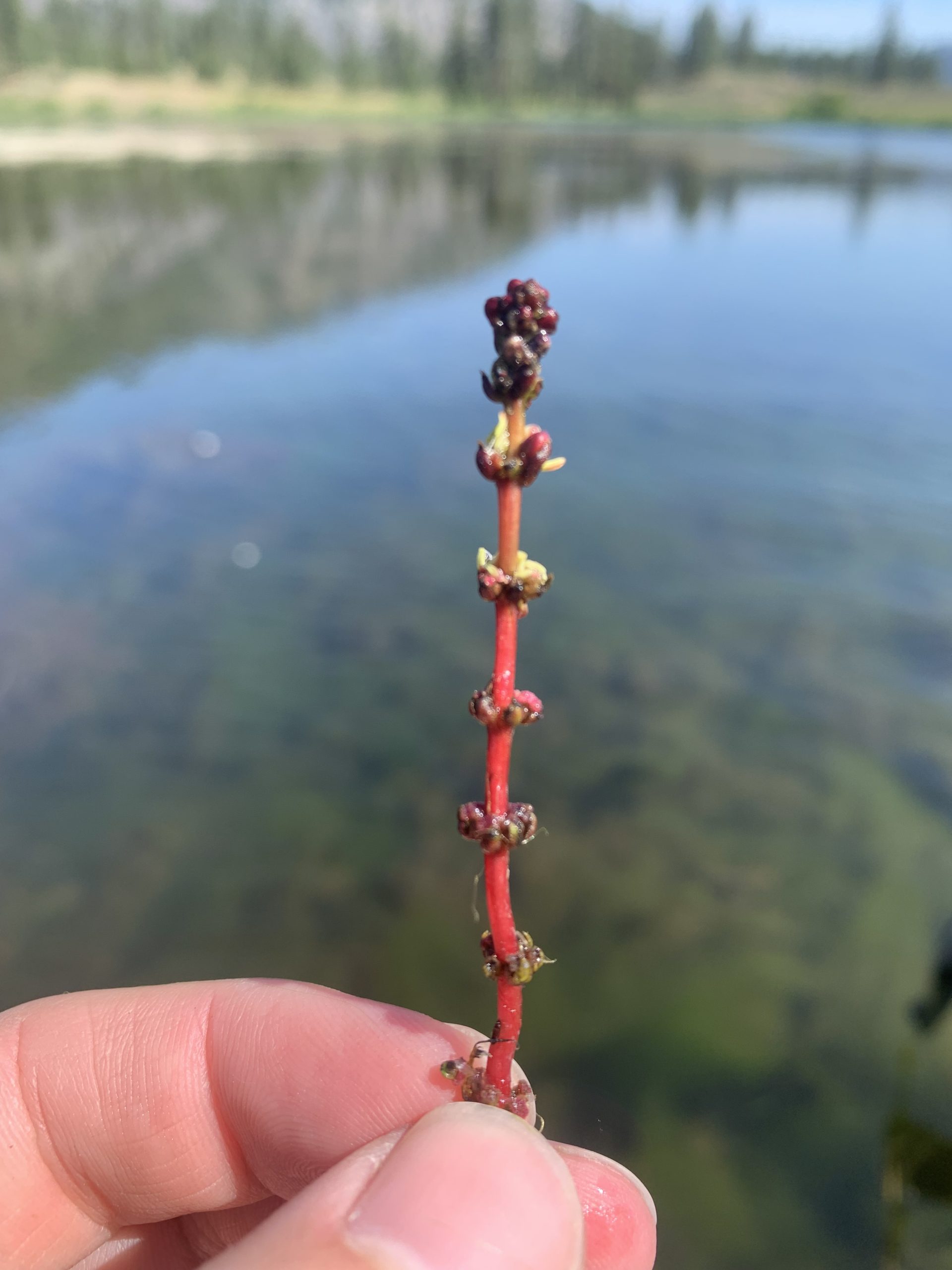
Emergent flower spike of northern watermilfoil (Myriophyllum sibiricum) with male flowers above and female flowers below PHOTO: WESLEY GLISSON
Washington state harbors nine species of watermilfoil and two hybrid taxa (see below). Three of these watermilfoil species are introduced and invasive: Eurasian watermilfoil from Europe, Asia, and Africa; parrotfeather (M. aquaticum) from South America; and variable-leaf watermilfoil (M. heterophyllum) from eastern North America. These are the species that even most novice botanists are familiar with. The first two are unfortunately common in the state and the same characteristics that make them so invasive are also those that make them so visible— their ability to grow abundantly and cover the water’s surface. It’s no surprise that our more well-behaved native watermilfoils are not as well observed. However, even if one did take the time to notice one of our native species, most of the time they would be hard-pressed to identify it. One resource that can help in identifying the various milfoils is here: https://bugwoodcloud.org/resource/files/33588.pdf.
While I disagree that only experts can distinguish these species, it’s clear that even among the botanically inclined, these are difficult species to identify with certainty. These challenges mean that genetic analysis is often the best tool to conclusively identify these species, which is not always feasible. Without easy identification of our native watermilfoils, appreciation and conservation of these species remain difficult.
Hybridization
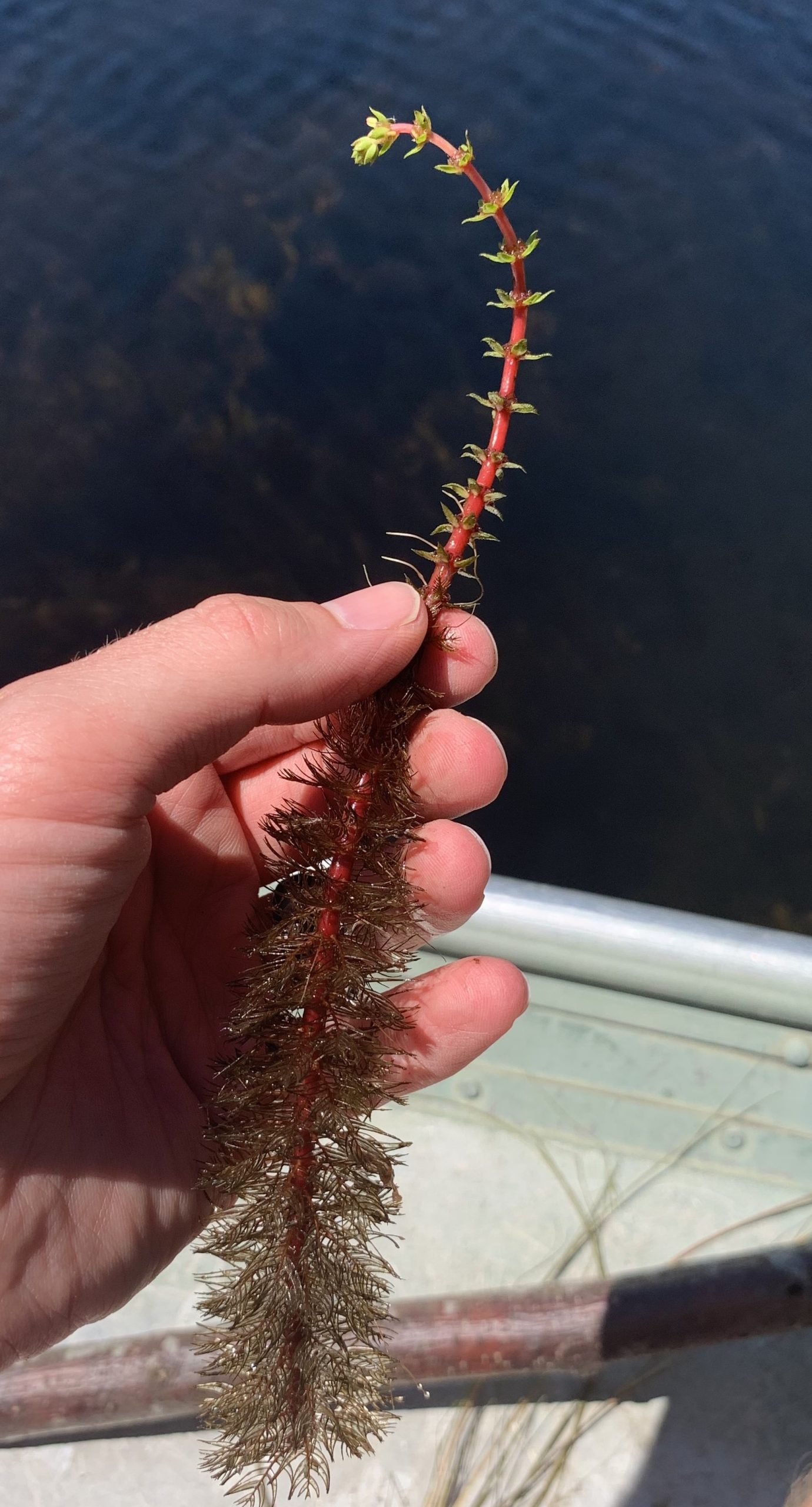
Variable-leaf watermilfoil (Myriophyllum heterophyllum) with submersed leaves below and emergent flower spike above with emergent leaves PHOTO: WESLEY GLISSON
The ability to observe and identify our watermilfoils can be improved with tools and practice, but harder to address is the threat posed to our native watermilfoils from their invasive cousins. First, species such as Eurasian watermilfoil can suppress the growth of our native aquatic plants, including native watermilfoils (Boylen et al. 1999). A second, and more cryptic issue, arises from just how closely related some of our native and invasive watermilfoils are: at least two of our native watermilfoil species hybridize with closely related invasive watermilfoils. Our native northern watermilfoil hybridizes with Eurasian watermilfoil, and our native western watermilfoil (M. hippuroides) hybridizes with variable-leaf watermilfoil. The northern and Eurasian watermilfoil cross (M. sibiricum × M. spicatum) was first confirmed in 2002 in several locations (Moody and Les 2002) and the western and variable-leaf cross (M. hippuroides × M. heterophyllum) in 2011 in Oregon (Thum et al. 2011).
For our native watermilfoils, hybridization can result in the replacement of native alleles and genes through introgression, where alleles and genes of the invasive species continually enter the gene pool of the native species. Given how readily these taxa hybridize (LaRue et al. 2013) and the distribution of these hybrids, introgression could result in the depletion of the native gene pool and the eventual extirpation of our native species. In addition, for hybrids of Eurasian and northern watermilfoil, these appear to grow more aggressively than pure Eurasian watermilfoil, which could result in greater competition of hybrids with northern watermilfoil and other native aquatic plants (Glisson and Larkin 2021). Finally, hybridization makes identification of this already challenging genus even more difficult (Moody and Les 2007). For watermilfoil specimens with intermediate traits of parental taxa, genetic analysis is the only route for identification.
Because they are so difficult to identify, watermilfoil hybrids have likely spread beyond our current understanding of their distributions in Washington. Hence, the true impact on our native watermilfoils is largely unknown. In the Midwest, hybrids of Eurasian and northern watermilfoil are widespread and likely displacing populations of northern watermilfoil (Eltawely et al. 2020). While more data are needed, the same may be happening here. Both hybrid watermilfoil taxa are listed as noxious weeds in Washington, which is a huge step in informing the public and controlling their populations. Pure variable-leaf watermilfoil and hybrids of variable-leaf and western watermilfoil have limited distributions in the state, so we stand a real chance of mitigating further harm to our uncommon native western watermilfoil. However, this requires diligence and awareness for all those working in and on the water.
Conclusion
In line with another bumper sticker I have seen while on the road (“Start seeing motorcycles”), I encourage readers to “Start seeing milfoils!” Not all aquatic plants are milfoil, and not all milfoils are Eurasian watermilfoil. There are indeed challenges to the conservation of our native watermilfoils, but overcoming these challenges is possible by: 1) addressing the (aquatic) plant blindness that limits our interaction with them, 2) familiarizing ourselves with how to identify our native and invasive watermilfoils, and 3) documenting occurrences of these species and hybrid taxa. This starts with visiting the weedier parts of a waterbody and pulling those plants out of the water to take a closer look. While identification is difficult, it is not impossible. Start by looking for any emergent flower spikes, and then go to the submersed leaves and count the segments. There are other tools to help you determine where our native watermilfoil species have already been documented, such as the Burke Herbarium Image Collection (burkeherbarium.org/imagecollection), Ecology’s Lakes Environmental Database (apps.ecology.wa.gov/lakes), and the new Milfoil Mapper online tool (thumlab-msu-watermilfoilapp.shinyapps.io/milfoil_app).
If you are still stumped and/or think you may have an invasive watermilfoil species on your hands, contact the Department of Ecology or your county noxious weed program for assistance. Breaking the barrier of the water’s surface and identifying these species are important steps by themselves, but these will also help determine the extent and magnitude of watermilfoil hybridization—a major threat to our native watermilfoil species. Together, addressing these three areas can improve the appreciation and conservation of our native watermilfoils.
Literature cited
Boylen, C.W., L.W. Eichler, and J.D. Madsen. 1999. Loss of native aquatic plant species in a community dominated by Eurasian watermilfoil. Hydrobiologia 415:207–211.
Eltawely, J.A., R.M. Newman, and R.A. Thum. 2020. Factors influencing the distribution of invasive hybrid (Myriophyllum spicatum x M. sibiricum) watermilfoil and parental taxa in Minnesota. Diversity 12:120.
Glisson, W.J., and D.J. Larkin. 2021. Hybrid watermilfoil (Myriophyllum spicatum × Myriophyllum sibiricum) exhibits traits associated with greater invasiveness than its introduced and native parental taxa. Biological Invasions 23:2417–2433.
LaRue, E.A., D. Grimm, and R.A. Thum. 2013. Laboratory crosses and genetic analysis of natural populations demonstrate sexual viability of invasive hybrid watermilfoils (Myriophyllum spicatum × M. sibiricum). Aquatic Botany 109:49–53.
Moody, M.L., and D. H. Les. 2002. Evidence of hybridity in invasive watermilfoil (Myriophyllum) populations. Proceedings of the National Academy of Sciences of the United States of America 99:14867–14871.
Moody, M.L., and D.H. Les. 2007. Geographic distribution and genotypic composition of invasive hybrid watermilfoil (Myriophyllum spicatum × M. sibiricum) populations in North America. Biological Invasions 9:559–570.
Parsley, K.M. 2020. Plant awareness disparity: A case for renaming plant blindness. Plants People Planet 2:598–601.
Alaback, P., Antos, J., Goward, T., Lertzman, K., MacKinnon, A., Pojar, J., Pojar, R., Reed, A., Turner, N., & Vitt, D. 2004. Plants of the Pacific Northwest coast: Washington, Oregon, British Columbia and Alaska (J. Pojar & A. MacKinnon, Eds.; Revised edition). Lone Pine Publishing.
Thum, R.A., M.P. Zuellig, R.L. Johnson, M.L. Moody, and C. Vossbrinck. 2011. Molecular markers reconstruct the invasion history of variable leaf watermilfoil (Myriophyllum heterophyllum) and distinguish it from closely related species. Biological Invasions 13:1687–1709.
Wandersee, J.H., and E.E. Schussler. 1999. Preventing Plant Blindness. The American Biology Teacher 61:82–86.