
by Sam Castro (MLIRD) & Ryan van goethem, CLM (EUTROPHIX)
 Project Overview
Columbia Basin Conservation District (CBCD) and Moses Lake Irrigation & Rehabilitation District (MLIRD) received federal funding to perform a large phosphorus (P) mitigation demonstration project. In 2024 and 2025, EutroPHIX and Aquatechnex implemented this work, which involved mitigating phosphorus Rocky Ford Creek with EutroSORB® WC, and a large-scale sediment treatment in the Rocky Ford Arm with EutroSORB® G. A previous Waterline article describes this work in detail.

Map of Moses Lake, WA with the project areas highlighted in blue
Final Project Results
A comprehensive monitoring program was implemented on Moses Lake in 2024-2025 to track changes in water quality from the phosphorus mitigation treatments, along with a comparison to the long-term water quality monitoring data collected by MLIRD. Final results from the past two years have been reported to CBCD and MLIRD demonstrating significant improvements in water quality from these efforts. The injection of EutroSORB WC in Rocky Ford Creek reduced soluble-reactive phosphorus, on average, 36-63% downstream while in operation. After the application of EutroSORB G, there was a steady decline in total phosphorus in the bottom waters by >32% to September 2024. Additional sediment analyses confirmed the product EutroSORB G was binding phosphorus efficiently as rhabdophane and monazite (LaPO4), with additional binding capacity for phosphorus available 16 months after application.
Summer total phosphorus concentrations in Rocky Ford arm at the water’s surface averaged 35 µg/L in 2024 and 31 µg/L in 2025. These 2024 and 2025 total phosphorus concentrations were 54-59% lower than historical years with similar Columbia River water (CRW) mixing from dilution, demonstrating the impact P mitigation had on improving water quality in the Rocky Ford Arm of the lake. There was a similar finding for algae biomass measured as chlorophyll-a. The algae community biovolume across the summers of 2024 and 2025 was dominated by beneficial green algae and diatoms, with cyanobacteria representing only an average 32% biovolume in 2024 and 16% in 2025. Historically this region of the lake had high cyanobacteria levels leading to HAB advisories and long recreational closures.

Comparison of total phosphorus (left) and chlorophyll-a (right) across comparable years with 40-60% CRW mixing from dilution. 2024 and 2025 show major reductions compared to comparable historical years.
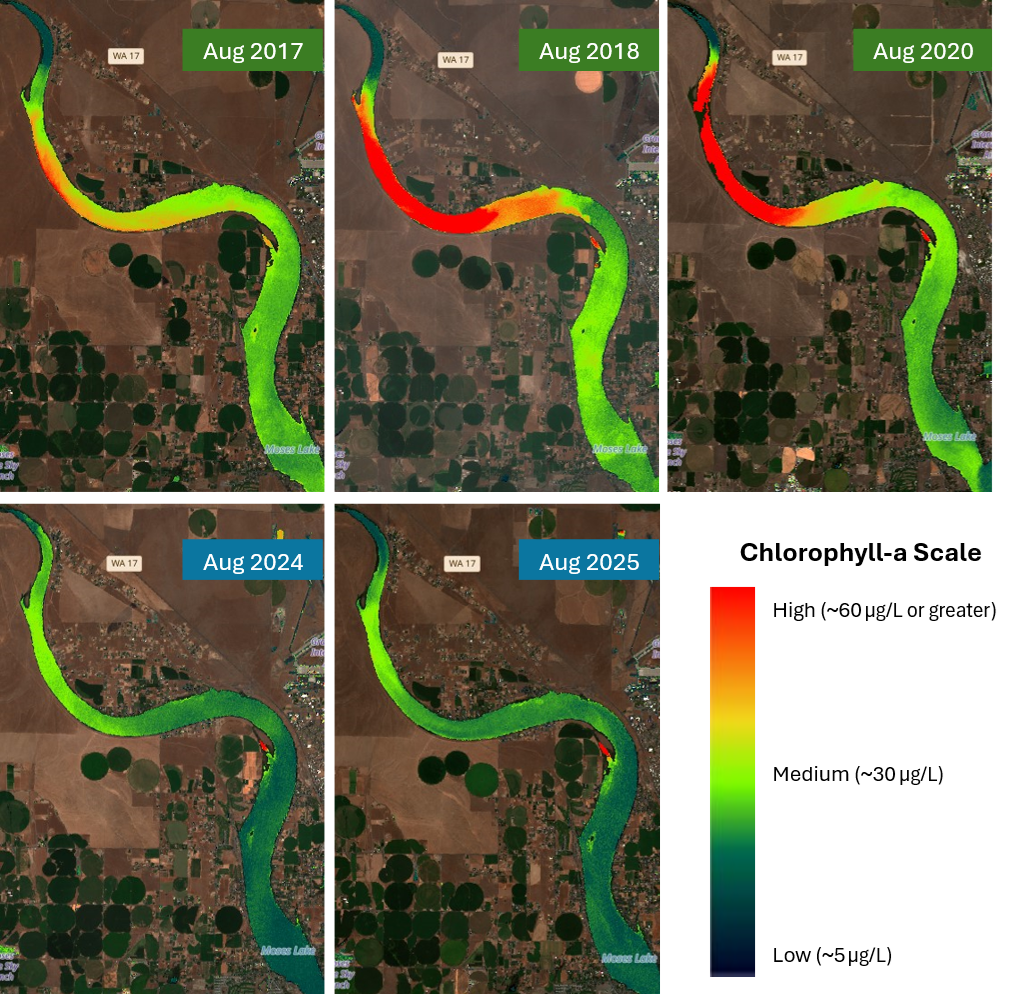
Visual comparison of algae across years with 40-60% CRW mixing during typical peak algae biomass by satellite analyses. Historical years are 2017, 2018, and 2020. Years with P mitigation were 2024 and 2025 demonstrating a significant reduction in chlorophyll-a across Rocky Ford Arm. Images contain modified Copernicus Sentinel-2 data from 2017-2025.
Conclusions
This demonstration project highlighted that internal and external P mitigation will further improve water quality beyond CRW dilution to provide favorable water quality conditions. P mitigation technologies of EutroSORB G and EutroSORB WC are proven, scalable, and safe for this role in Moses Lake. Local stakeholders are actively engaged in the Moses Lake Watershed Council to build a better water quality future. Efforts continue to manage nutrient loads from the watershed over the long term, improve water management and lake dilution, and do in-lake management supported by science. This work is vital as the community deserves clean, safe, and enjoyable water for the future of Moses Lake!
See the project video at: https://eutrophix.com/case-studies-news/ or read the final project report at: https://www.moseslakewatershed.org/lake-improvement-projects